Sunday, 25 March 2012

Wake up to the six o'clock clappers


The church clock was particularly loud this morning. I think someone had moved the church tower right outside my bedroom window. During the night we moved to summer time so really it was 5am when the village alarm clock went off.

It’s not crowing cockerels that gets life here going in the morning, it is the six o’clock clappers. Every day of the week, Sunday included, mass or no mass we get the usual hourly chime and then a bigger bell kicks in with over 100 rousing, resounding bongs. You can almost here the groans across the village as bare feet swing out from under the covers on to cold floors, and people stagger to the bathroom.

By 7am Annie and Marian have opened the shop, commuters are scraping ice off car windscreens and schoolchildren are assembling in their traditional locations, waiting for the school bus (boys around the bus stop and girls by the bank).

I have here in the past said that the Austrians are a calendrical folk – life's activities are arranged according to the calendar. They are also dictated to by the clock – or more accurately by the church bell. Once upon a time, workers were called in to lunch from the fields by bells housed in intricately carved belfries on the roofs of the farmhouses – they are still a feature of many old buildings today. But now the big bell takes over and at midday it booms again. work is put on hold, ski slopes and roads become quiet, hardly a soul is to be seen in the village, the shop has shut and everyone is enjoying lunch and possibly a snooze to follow.

The end of the working day at 7pm is signalled again by 100 hefty chimes – time to put up the feet and relax…except on Friday when, after a long working week, the bells begin the weekend with a jubilant volley at 3pm and there is a festive air in the village.

The only exception to this noisy routine is in the few days before Easter when the bells “go to Rome”. Well, not literally, but this is what we are told. It is really that their joyous cacophony is inappropriate at such a sombre time in the church’s calendar. The village falls silent – fortunately there is no school so there is no bus to miss, the shop doesn’t open on Good Friday anyway and businesses and banks are closed. Lunch, though, may be a little late without the church to remind the cook.

How do we manage to get out of bed on these days? Instead of bells, someone stands outside the church swinging what can only be described as a very large rattle, of the sort that used to be heard at soccer matches. It's not as insistent and easier to ignore – it might just be possible to sleep through this noise, but who can sleep in this unaccustomed silence?

Wednesday, 14 March 2012

The colorful politics of rural life


Embach with its twin, Lend have a quarterly magazine mainly about social activities the schools and council. Those of us who help produce it are proud of its quality and it is popular among residents. Being one of the production team for a number of years, I have often been surprised by the strength of political feeling which permeates deep into life here, so far from the nation's capital.

Embach and its bigger twin sister village, Lend, are united by a single council with its own mayor and deputy mayor with considerable control over finance and other activities.

However, these are unalike twins. Lend, down in the valley is an industrial village dominated by a large aluminium manufacturing plant. Embach, 500m higher, is a farming village with many small, traditionally-run dairy farms.

Lend, because of its location in a narrow valley, is considered rather gloomy because of its lack of sunlight, whereas Embach lies on a sunny plateau. The people of one village, participate little in the activities of the other.

Lend is red while Embach is black. Political parties are defined by colour – red leans naturally to the left and black to the conservative right. Move further right and you come to blue and orange. And so the two villages are not only unalike, but in many respects they appear unrelated.

The village magazine, the IGEL, the intials stand stand for Information from the Gemeinde (council) Embach and Lend, but the word also means hedgehog - is sponsored by the SPƖ – the left wing political party. Their logo appears on the title page and there is a single page advertisement inside. There are some politically involved members of the production team but there is no overriding political message.

However, it is always brought home to me during the production cycle, how deeply ingrained and immovable are the differences between the red and black communities, differences which permeate many other aspects of life in Austria.

Take, for example, the motor rescue services or the banks. Until recently I was unaware, than one bank was more red or black than another. But it explains why Embach has one bank and Lend another – and possibly why only one of them advertises in the IGEL.

On a more local level, the village ski club may lean in one direction and the eisstockschießen (it's like curling) club in another. That one group is “black” while another is “red” is not obvious until it is time to put the magazine together, when political leanings creep in While my training is to assess a story by its newsworthiness, here,an additional factor,the shades of political color may be taken into account.

If you are born and bred here, the colour of your politics are embedded in your DNA and unlikely to change. Though they remain invisible to the incomer, they play an important role and exert an influence even in the most rural community. The strength and depth of politics in the countryside is disproportionate to the blandness of the grand coalition in Vienna.

There's no right or wrong about this – it only clarifies the obvious, that DNA is inherited and however long you live as an incomer in another country, you'll never fully absorb the local genes.
The IGEL production team proofreading a recent issue

Sunday, 4 March 2012

Champion old-timer skiers race in Embach


Wouldn't you just believe it! While the ski industry is busy developing skis that are faster, safer and easier to learn on, and clothing companies are turning the slopes into a couturier's catwalk, there is a body of enthusiasts resurecting the time when skiing was done in woolly clothes on simple wooden boards.


The Nostalgie ski racing in Embach over the weekend attracted a hundred racers, some from as far away as Berlin and Slovenia as well as from Embach and neighbouring villages. Not only did they come with ancient, long, wooden skis but they dressed the part as well.

Much in vogue were lederhosen or plus-fours and bushy beards for the men, and ankle-length, flowing, heavy skirts hiding thick woolly socks for the women. Hats were adorned with badges and often with the old-style aviator goggles – later to be pressed tight across the eyes as they rushed down the slopes.

Believe it or not, Embach was playing host not only to a bunch of ski-nostalgia enthusiasts but former nostaliga world and national champions.

The racing is divided into two broad categories – those on the most basic of skis with no metal edges to help with the cornering, and those slightly more recent models with „kanten“ and from there by age and gender.

Speeding round the gates, skirts and baggy trousers flapping in the wind, crouched to gain the maxium speed and occasionally coming a-cropper. the racing on these skis requires special skills and often a long wooden pole to help with the steering. Modern bindings which release the ski during a fall, don't qualify, so mistakes can be painful.


It wasn't just the skis which were the old-timers – not surprisingly some of the best skiers had grown up the hard way riding on these unwweildy boards and could show all the flash young freeskiers a thing or two.


The Embach Nostalgie Ski Team


Friday, 2 March 2012

Head's up! Mozart is back

Mozart is back! After 10 weeks being invisible, buried in snow, the one meter high stone statue of a boy, nicknamed Mozart, which stands on our terrace, is gradually reappearing. First just the top of his head, but day by day more of him is coming into sight as the snow retreats.
Mozart yesterday (above) and 24 hours later (below)
Spring is in the air. Walking up from the village this week I could feel the warmth of the sun on my back. The snow beside the road was still at shoulder height, but the ever present sounds of dripping and fast appearing puddles is a sure sign that winter, which has blown and dumped snow on us since before Christmas, is now exhausted and apart from a few feeble attempts to bring more snow, it is making a hasty exit.

In the garden the taller bushes are reappearing, crouching like old crones under the weight of the snow, but waiting to spring back upright again. Gutters and drainpipes play a constant gurgling symphony, only stopping at night as temperatures drop. The track to our house has changed from deep snow, first to ice, then slush and now to mush – the Americans call it the mud season.

Along the roads, the mountains of white piled high by snow ploughs, are turning a dirty brown and road signs and fence posts are lying battered and bruised from the efforts to push the mass of snow aside and keep the roads clear.

Other treats are in store: going out without a coat, people strolling past the house in the sunshine, sitting in the sun on the terrace, and planning activities of coming months.

Meanwhile Embach is preparing for Nostalgie Schirennen – skiing on ancient wooden skis while dressed as they did in the good old days. Watch this space.

Tuesday, 21 February 2012

Greener winter sport is not for softies

After a week of racing down the piste despite frostbite temperatures and skin-peeling gales, it was time for some greener winter sports.

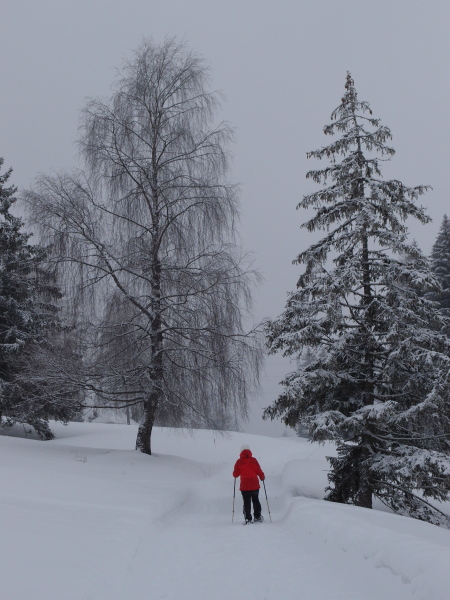
Snow shoe walking is often described here as “sanft” which translates as soft or gentle. But though it is gentle on the environment, don’t get the idea that it is for softies.

Snow shoes no longer look like tennis rackets. An aluminium frame with harness for hiking or snowboard boot which is hinged so that the foot lifts from the heel as usual, they are equipped with fearsome teeth underneath to help grip the snow.


If you can walk, you can enjoy this winter sport. Just put one foot in front of the other as usual and the woods and the wilderness are waiting for you to come and explore.

Very often it is a monochrome world. After a big snow fall the forest tree trunks stand dark on one side, and contrasting white with snow on the other, their branches mirroring this black and white effect.

Walking through the woods, you don’t need much imagination to feel dwarfed by all around you, and even slightly tentative; do Hansel and Gretel come to mind?

What lies beneath the huge mounds of snow which loom on either side of your track, rounded and still? Ant heaps, small bushes and nascent trees. What made these tracks that cross the trail? Deer, chamois, hares, foxes and birds are all busy surviving these cold, snow rich months. Behind, you are leaving a trail the yeti would respect.

Walking with snow shoes can be strenuous at times when no one has gone before to make a trail. But it is rewarding and healthy, sucking down the cold fresh air. Down hill in powder, you can half slide, half glide with almost effortless grace.

Adventure awaits, you only need snow shoes, ski poles and a bit of imagination.

Friday, 10 February 2012

After the big snow, the big freeze

After some weeks of steady snowfall, the past 10 days or so have seen little added to the mountains of white in the garden but temperatures have been down in the ice cellar. Only in the past day or so did they rise above minus 10C and then only to six below zero. Today it is once again below minus 10.

The effect on Embach appears to be exactly zero: people going about their daily lives as usual, schoolchildren waiting for the school bus in the early morning, parents driving to work, holidaymakers skiing, enjoying the cross-country circuit and joining ski classes. Life goes on uninterrupted, bordered by vertical walls of ice along the roads, and great piles of snow left by Pauli and his snow plough.
Nestling under thick white duvets

There are however minor irritations of such a cold snap: just the dressing and undressing each time we want to go outside as it takes time to put on boots and socks, hat, scarf, gloves, jumper and jacket. Then on coming in, the process goes into reverse with the added aggravation of steamed up spectacles. There is the frequent necessity for nose blowing, the contents of the compost bin, uncovered from under two metres of snow, are frozen, the car is a terrible mess and can’t be washed because the water would freeze (this could be seen as a benefit), the birds have already chomped their way through 40kg of sunflower seeds and so on.

But would we want it any other way? No, of course not! Winter is a magical time especially at these temperatures. The landscape twinkles in the sunlight, the air is crisp and the snow groans and crunches underfoot, the tracks in the garden reveal the myriad of night time visitors, the houses nestle under thick, fluffy white duvets and when it snows, tiny glistening crystals fall gently dusting the snow with a fresh powdery coat.

Embach is especially beautiful at this time – but then, I say that at every season.
The roads are bordered with walls of ice and snow

Thursday, 2 February 2012

Bad hair day? Blame the Moon

A few days ago I had my hair cut. I was the only customer in the normally busy hairdresser’s and Evelyn said as she snipped away that January is normally a quiet month…”and then there is the moon calendar…but it’s too late for you now”.

The phases and positioning of the moon in conjunction with the star signs and the elements, as indicated on the Moon Calendar dictate which day is a good day for a hair cut and what is not. Hairdressers are busy or quiet according to this calendar.

There’s much more to it than just the hair. The moon calendar is used my many people here to choose appropriate days for many things from personal health and wellbeing, to farming and gardening, and on household activities and maintenance.

The principle is that, just as the moon creates the ocean tides, so it influences the rising sap in our plants and also the working of our bodies.

Every day on local radio, in newspapers and in a variety of calendars and diaries we are told that it is not a good day for, for example, removing warts, or drilling a well, that fattening foods work better on this day or that botox will last longer if applied today, that it is a good day for cleaning windows and for spreading manure on the garden.

Until I came to Austria I had never heard of the moon calendar and as a sophisticated former city dweller was pretty sceptical…in fact I thought it a bit of a joke like horoscopes. Before writing this I looked it up on Wikipedia – and even in that all-knowing corner of the internet, found no reference to the moon’s influence on haircuts or removing warts.

However, over the years I have come to greatly respect the farmers in Embach. They are all small family micro-businesses working on the steepest of hillsides often in harsh weather conditions. There is no room in their budgets for wastage and families with rakes and hand mowers help each time the hay has to be cut making sure nothing is lost. In winter the cows are cared for by hand in the stalls.

Working in such close harmony with nature, and with generations of experience behind them, I am now sure they know more about the influence of the moon on their work than Wikipedia does. If they have learned these lores from their ancestors and still apply this know-how today, then there must be something in it. And what works for one crop must also be relevant for house plants and when planting out in the garden.

On the day of writing this the moon calendar advised voice, speech, ears, nose and throat were vulnerable and should be protected. As it is 10 Celcius degrees below zero with an icy wind – that seems pretty sound. Whether I would ever notice whether it was a good or bad day for cleaning windows, I can’t say.

But my haircut on that “bad hair” day? Yes it really bears out the Moon Calendar advice, I should have stayed away. But then, as Evelyn said, it was too late by the time I found out.

Rising above Embach over the Baugkogerl - did the Moon really affect my haircut?